از پیام مشتری تا پاسخ هوشمند؛
ساخت یک تیم AI Agent
یک Coding Session زنده برای ساخت یک سیستم چندعاملی پشتیبانی مشتری
در این جلسه میبینیم چطور یک CRM معمولی با Agentic Workflowها به سیستمی تبدیل میشود که خودش پیام مشتری را میفهمد، دستهبندی میکند و پاسخ میدهد.
در این جلسه چه میبینیم؟
اپلیکیشنها و ایجنتهای از پیش ساخته CRM
هر CRM مدرن سه بازو دارد و در هر بازو، تیمی از ایجنتها کار واقعی را انجام میدهند.
بازاریابی
جذب مخاطب، ساخت کمپین و تبدیل توجه به سرنخ فروش.
فروش
مدیریت فرصتها، پیشفاکتور و پیشبینی درآمد تا بستن قرارداد.
خدمات مشتری
پاسخ به پیام مشتری، حل درخواستها و نگهداشتن رضایت او.
تمرکز این پروژه: فروش و خدمات مشتری؛ یعنی موفقیت مشتری (Customer Success).
ایجنتهای از پیش ساخته برای اتوماسیون بازاریابی
از تولید محتوا تا سنجش اثر هر کانال، ایجنتها چرخه کمپین را سریعتر میچرخانند.
اپلیکیشنها
جایی که داده و فرآیند زندگی میکندایجنتها
جایی که تصمیم و اقدام اتفاق میافتدایجنتهای از پیش ساخته برای اتوماسیون فروش
ایجنتها کارهای تکراری فروشنده را برمیدارند تا او روی مذاکره و بستن قرارداد تمرکز کند.
اپلیکیشنها
جایی که داده و فرآیند زندگی میکندایجنتها
جایی که تصمیم و اقدام اتفاق میافتدایجنتهای از پیش ساخته برای اتوماسیون خدماتتمرکز این وبینار
همان بخشی که امروز میسازیم: ایجنتها پیام مشتری را میفهمند، دستهبندی میکنند و پاسخ میدهند.
اپلیکیشنها
جایی که داده و فرآیند زندگی میکندایجنتها
جایی که تصمیم و اقدام اتفاق میافتدچه چیزی میسازیم؟
یک سیستم چندعاملی موفقیت مشتری که:
- دادههای CRM را پایش میکند
- مشتریان در خطر را پیدا میکند
- علت را از روی شواهد میفهمد
- بهترین اقدام بعدی را پیشنهاد میدهد
- و فقط پس از تأیید انسان، اقدام را اجرا میکند
چرا ایجنتیک ورکفلو؟
یک قانون ثابت
IF revenue < threshold THEN create_task
نمیداند چرا درآمد افت کرده؛ افت فصلی و ریزش واقعی را یکسان میبیند.
بررسی، استدلال، تصمیم
ایجنتها شواهد را از چند منبع جمع میکنند، فرضیهها را میسنجند و فقط وقتی اقدام لازم است، آن را پیشنهاد میدهند.
ایجنت و ایجنتیک ورکفلو
یک LLM که با ابزار و حافظه، خودش تصمیم میگیرد برای رسیدن به هدف چه کند.
چند ایجنت با هدفهای جدا که یک هماهنگکننده آنها را در یک فرآیند کنار هم میگذارد.
حافظه و پنجره زمینه
حافظه یعنی هر چیزی که ایجنت نگه میدارد تا تصمیم بعدی را بهتر بگیرد.
پنجره زمینهContext Window
همه چیزی که مدل در یک لحظه میبیند. محدود است؛ پس فقط چیزهای لازم را در آن میگذاریم.
API، MCP و Webhook
ایجنت بدون اتصال فقط حرف میزند؛ با این سه، داده میخواند، کار انجام میدهد و از اتفاقها باخبر میشود.
ایجنت از یک سرویس داده میخواهد یا از آن کاری میخواهد و جواب میگیرد.
یک پروتکل باز که ابزارها و دادهها را یکبار تعریف میکند تا هر ایجنتی از آنها استفاده کند.
وقتی اتفاقی میافتد، سرویس خودش به آدرس ما خبر میدهد و ورکفلو شروع میشود.
زبان مشترک ایجنتها
الگوهای ارکستریشنOrchestration Types
حالتمندStateful
همه ایجنتها یک وضعیت مشترک را میخوانند و بهروز میکنند؛ مسیر بعدی از روی همین وضعیت انتخاب میشود.
تحویلHand-off
هر ایجنت کار را همراه با زمینه لازم به ایجنت بعدی میسپارد؛ کنترل دستبهدست میشود.
ناظرSupervisor
یک ایجنت ناظر کار را تقسیم میکند، به ایجنتهای متخصص میسپارد و نتیجه را جمع میکند.
کیتهای توسعه سازندههاAgent SDKs
ابزار رسمی هر سازنده مدل؛ شروع سریع، اما وابسته به همان اکوسیستم.
پکیجهای مستقل از مدلAgnostic
با هر مدلی کار میکنند؛ کنترل کامل روی گراف، وضعیت و تحویلها.
کوچک، اما واقعی
تمرکز ما استدلال و اقدام ایجنتی روی داده ساختاریافته CRM است، نه ساختن یک محصول کامل.
چه چیزی میسازیم
- یک دیتابیس CRM کوچک با ۸ جدول مرتبط
- داده مصنوعی علّی با ۱۰ داستان رفتاری مشتری
- لایه ابزار برای خواندن، تحلیل و اجرا
- پنج ایجنت تخصصی با خروجی ساختاریافته
- صفحه تأیید انسانی و اجرای اقدام (تسک و ایمیل)
- ارزیابی خودکار در برابر حقیقت پنهان داده
چه چیزی نمیسازیم
- احراز هویت و فرانتاند پیچیده
- اتصال به CRM یا مشتریان واقعی
- دیتاستهای حجیم و مدلهای ML پیچیده
- RAG روی هزاران سند
- Fine-tuning
ما پنج چتبات نمیسازیم؛ یک فرآیند کسبوکار را با تیمی هماهنگ از ایجنتها پیاده میکنیم.
معماری کامل، از داده تا اقدام
محیط آزمایش کنترلشده
داده مصنوعی علّیcrm.sqlite + ground_truth.json
دیتاست آماده: ۵۰ مشتری در ۶ ماه، ۹ جدول. هر مشتری یک داستان پنهان دارد که همه جدولها را با هم تغییر میدهد.
پشته فنیTech Stack
- Python، SQLite و FastAPI برای بکاند
- Next.js برای صفحه تأیید
- AvalAI برای مدلهای زبانی (سازگار با OpenAI)
- Resend برای ارسال ایمیل
ایمنی و خودمختاریSafety & Autonomy
ایمیلها پیشفرض ارسال نمیشوند: dry_run، redirect یا live.
چهار سطح خودمختاری: از «فقط پیشنهاد» تا «اجرای خودکار اقدامهای کمریسک».
معیارهای ارزیابیEvaluation Metrics
تشخیص رویداد، درستی علت، کیفیت شواهد، دستهبندی وضعیت مشتری، کیفیت اقدام و تعداد فراخوانیهای غیرضروری ابزار.
پنج ایجنت، پنج مسئولیت
نقشه راه ساخت، مرحله به مرحله
از ساده به پیچیده: ایجنت تکی، بعد workflow ثابت، و فقط در صورت نیاز حلقه ایجنتی. هر مرحله یک commit مستقل است.
مرحله ۰: راهاندازی و طراحی (بخش ۱ از ۲)
Read docs/PROJECT_SPEC.md. It defines a multi-agent CRM customer-success system.
Do not write application code in this stage.

PRINCIPLES (apply to every stage):
- Simple to complex: augmented LLM (LLM + tools + structured output) → fixed workflow → agent
  loop. Add complexity only when needed and document why.
- Per stage: Explore → Plan → wait for approval → Implement → Test → Commit (tag stage-XX).
- Numbers come from SQL/Python. The LLM only reasons and decides.

STACK:
- Backend: Python 3.11+, uv, SQLite, FastAPI, pydantic v2, pytest, typer, rich.
- LLM: AvalAI (OpenAI-compatible), called through the openai SDK with a custom base_url.
- Email: Resend. Frontend: minimal Next.js (TypeScript) app in /web, for approvals only.
- Data: the provided dataset in data/ (spec section 2). Never generate or modify it.

TASKS:
1. Summarize the spec in 10 bullets or fewer.
2. Create the structure:
   backend/src/crm_agents/{db, tools, analytics, llm, agents, orchestrator,
   execution, approval, evaluation, tracing, api}/
   backend/tests/, backend/scripts/, docs/, web/ (README only)
   data/ already contains crm.sqlite and ground_truth.json; leave both untouched.
3. Create AGENTS.md with these rules:
   - Readable code: clear names, docstrings, short functions, type hints.
   - Every agent input and output is a pydantic model.
   - Agents access data only through tools/. Only evaluation/ may read ground_truth.json.
   - data/crm.sqlite is read-only; the app reads and writes a working copy (DB_PATH).
   - Only llm/client.py imports openai. Only execution/email.py imports resend.
مرحله ۰: راهاندازی و طراحی (بخش ۲ از ۲)
   - Every stage ships with tests. Never start the next stage without approval.
4. Create docs/ARCHITECTURE.md (agents, responsibilities, allowed tools, schemas, authority
   limits) and docs/STAGES.md (per stage: goal, deliverables, "why an agent, not a rule").
5. Create .env.example:
     AVALAI_API_KEY=
     AVALAI_BASE_URL=https://api.avalai.ir/v1
     LLM_MODEL=
     LLM_MODEL_CHEAP=
     RESEND_API_KEY=
     RESEND_FROM=
     EMAIL_MODE=dry_run        # dry_run | redirect | live
     EMAIL_REDIRECT_TO=        # redirect mode sends every email here
     AUTONOMY_LEVEL=1          # 1..4
     DB_SOURCE=data/crm.sqlite
     DB_PATH=data/crm_work.sqlite
     GROUND_TRUTH_PATH=data/ground_truth.json
     API_URL=http://localhost:8000
6. Create backend/pyproject.toml and llm/client.py: chat, tool calling, structured output
   parsed into pydantic (one repair retry on invalid JSON), network retries, and logging of
   model, tokens, and latency. Add a smoke test that is skipped without AVALAI_API_KEY.
7. Propose the plan for Stage 1.

Commit "stage-00: setup and design". Stop and wait.
مرحله ۱: بارگذاری و کاوش داده
Stage 1: load and understand the provided dataset. Read AGENTS.md first.
The dataset already exists. Do not generate or modify data.

INPUTS:
- data/crm.sqlite: 9 CRM tables (docs/PROJECT_SPEC.md, section 2).
- data/ground_truth.json: hidden story per customer. Evaluation only.

TASKS:
1. scripts/reset_db.py: copy DB_SOURCE to DB_PATH. Every later stage uses only DB_PATH.
2. db/connection.py: open DB_PATH with foreign keys on and rows returned as dicts.
3. db/models.py: pydantic models for the 9 tables, matching the actual columns.
4. docs/DATA.md, generated from the database itself: tables, columns, row counts, date range,
   allowed values of status/category/sentiment fields, and table relationships.
5. scripts/describe_data.py: per customer and month: revenue, orders, tickets by category,
   interactions, negative-sentiment share, overdue invoices. Print a compact table.
6. evaluation/ground_truth.py: the only loader of ground_truth.json.

EXPLORE (write in docs/STAGES.md): pick 3 customers with different patterns and describe what
the numbers suggest, without looking at the ground truth. Then compare with it.

TESTS: row counts match docs/DATA.md, foreign keys are valid, reset_db is repeatable,
no module outside evaluation/ references ground_truth.json.

Commit "stage-01: dataset". Stop and wait.
مرحله ۲: لایه ابزار و تحلیل
Stage 2: tool layer and deterministic analytics. Read AGENTS.md first.

Use the real column names from docs/DATA.md.

READ TOOLS (tools/read.py), each returning pydantic models with capped result sizes:
get_customer, get_contacts, get_orders(customer_id, start, end),
get_invoices(customer_id, status), get_interactions(customer_id, start, end),
get_support_tickets(customer_id, status), get_opportunities, get_tasks,
get_business_events(customer_id).

ANALYTICS (analytics/), pure SQL/Python:
monthly_revenue, revenue_trend, order_frequency, engagement, support_pressure (by category),
payment_risk (overdue count and amount), sentiment_trend, compare_periods.
Each returns numbers plus a one-line plain-language summary.

REGISTRY (tools/registry.py): every tool has a name, description, JSON schema generated from
its pydantic input, and a Python function. The registry is the only thing the LLM sees.

GUARD: no tool can read ground_truth.json. Add a test that proves it.

TESTS: every tool and metric on known customers from the dataset.

Commit "stage-02: tools and analytics". Stop and wait.
مرحله ۳: ایجنت تکی با ابزار
Stage 3: a single agent with tools (augmented LLM). Read AGENTS.md first.

Build agents/customer_analyst.py that answers "What is happening with customer X?"

- Loop: the LLM picks tools from the registry, tools run, results return, repeat until a
  final answer or 8 steps maximum.
- Output (pydantic): summary, key_metrics, evidence[], hypotheses[{cause, supporting,
  contradicting, confidence}], open_questions.
- System prompt in agents/prompts/customer_analyst.md: role, tool list, "fetch only what you
  need", "use only numbers returned by tools".
- CLI: crm ask <customer_id>
- Log every step (tool, arguments, tokens, latency) as JSONL in tracing/.

EXPERIMENT (write results in docs/STAGES.md): one prompt with the full customer dump vs the
tool-based agent, on 3 customers. Compare tokens and answer quality.

TESTS: tool loop with a mocked LLM; one live test skipped without an API key.

Commit "stage-03: single agent". Stop and wait.مرحله ۴: تشخیص رویداد
Stage 4: event-driven trigger. Read AGENTS.md first.

Build agents/event_detector.py in two parts:
1. Deterministic scan (analytics only): flag candidate customers with a trigger reason,
   e.g. revenue drop + support pressure, overdue invoices, growing engagement and orders.
2. Cheap LLM triage (LLM_MODEL_CHEAP): choose event_type from CUSTOMER_HEALTH_CHANGED,
   PAYMENT_RISK_DETECTED, EXPANSION_SIGNAL, NO_ACTION, plus severity and trigger.
   It does not investigate.

Output a BusinessEvent model and store it in business_events with source 'scan_rule' or
'llm_triage'. Existing rows with source 'crm_alert' are the CRM's naive alerts; report where
the detector agrees and disagrees with them. CLI: crm scan

Document why detection is mostly rules and only triage uses an LLM.

TESTS: known archetypes produce the expected event types; healthy customers are mostly
NO_ACTION; seasonal_dip is not flagged as high severity.

Commit "stage-04: event detection". Stop and wait.
مرحله ۵: خط لوله چندعاملی
Stage 5: multi-agent pipeline with an orchestrator. Read AGENTS.md first.

AGENTS (each has its own prompt file, allowed tools, and pydantic input/output):
- ResearchAgent(BusinessEvent) → EvidencePack. Picks tools by event type
  (e.g. payment risk: invoices and orders first).
- AnalystAgent(EvidencePack) → Diagnosis: competing hypotheses, evidence for and against,
  primary cause, confidence. Analytics tools only.
- CustomerHealthAgent(Diagnosis + metrics) → HealthAssessment: state from HEALTHY, GROWING,
  EXPANSION_OPPORTUNITY, AT_RISK, PAYMENT_RISK, RECOVERING; temporary vs structural; rationale.
- NextBestActionAgent(HealthAssessment) → ActionProposal: action_type, priority, owner,
  task_summary, optional customer message draft, risk_level.

ORCHESTRATOR (orchestrator/pipeline.py):
- Fixed chain: event → research → analyst → health → next best action (prompt chaining).
- Routing: NO_ACTION stops early.
- Validate every output; retry once on invalid output, then fail the run with a clear error.
- Store each run with all intermediate outputs in a runs table, created in the working DB
  by db/migrations.py.
- CLI: crm run <customer_id> and crm run --all-events

TESTS: full pipeline with a mocked LLM, schema validation, early stop.

Commit "stage-05: multi-agent pipeline". Stop and wait.
مرحله ۶: اجرا، تأیید و ایمیل
Stage 6: execution, human approval, and autonomy levels. Read AGENTS.md first.

EXECUTION (execution/): create_task, update_task, create_note, update_customer_status,
prepare_customer_message, send_email. New tables (notes, messages, actions) go in
db/migrations.py and are created only in the working DB.
execution/email.py uses Resend according to EMAIL_MODE:
- dry_run: log only
- redirect: send every email to EMAIL_REDIRECT_TO
- live: send to the contact

POLICY (approval/policy.py), by AUTONOMY_LEVEL:
1 recommend only; 2 auto-create internal tasks and notes; 3 customer messages need approval;
4 low-risk actions run automatically, high-risk actions still need approval.
Every action has a status: proposed → approved/rejected → executed/failed, with who and when.

API (api/, FastAPI):
GET /runs, GET /runs/{id}, GET /approvals/pending,
POST /approvals/{id} {decision, edited_message?}, POST /scan, POST /run/{customer_id}

WEB (web/, Next.js + TypeScript, minimal, no auth):
- Pending approvals list.
- Detail view: event, diagnosis, health state, proposed action, editable email draft,
  Approve and Reject buttons.
- Run history.

TESTS: policy per level, email modes with Resend mocked, approval state transitions, API.

Commit "stage-06: execution and approval". Stop and wait.
مرحله ۷: ارزیابی
Stage 7: evaluation against ground truth. Read AGENTS.md first.

evaluation/ is the only module that reads ground_truth.json (via evaluation/ground_truth.py).
It resets the working DB, then runs the pipeline on all customers.

METRICS:
- Event detection: precision and recall of flagged customers.
- Diagnosis: LLM-as-judge (separate prompt) scores whether the primary cause matches the true
  archetype in meaning, not exact wording; store the judge's rationale.
- Health state: accuracy and confusion matrix.
- Action: appropriateness against a rule table per archetype.
- Evidence: every cited number exists in the tool outputs of that run.
- Efficiency: tool calls, tokens, and latency per run.
- False positives on healthy and seasonal_dip customers.

OUTPUT: evaluation/report.md and a JSON file. CLI: crm eval
Support comparing two evaluation runs (e.g. prompt v1 vs v2).

TESTS: unit tests for every metric function.

Commit "stage-07: evaluation". Stop and wait.
مرحله ۸: ردیابی و اجرای کامل
Stage 8: tracing and end-to-end run. Read AGENTS.md first.

- tracing/: one trace per run with every agent step (input, tool calls, output, tokens,
  latency). Add a page in web/ that shows the chain as a timeline.
- scripts/end_to_end.py: reset the working DB → scan → pick one AT_RISK
  service_failure customer → run the pipeline → wait for approval in the web UI → execute with
  EMAIL_MODE=redirect → print the updated CRM records and the next event.
- README.md: setup, environment variables, commands per stage, architecture diagram
  (mermaid), known limitations.
- Final check: all tests pass; no forbidden imports; no ground_truth.json access outside
  evaluation/; data/crm.sqlite unchanged.

Commit "stage-08: tracing and end-to-end run". Stop and wait.
ادامه مسیر، با من
اگر میخواهید این مسیر را عمیقتر و پروژهمحور ادامه دهید:
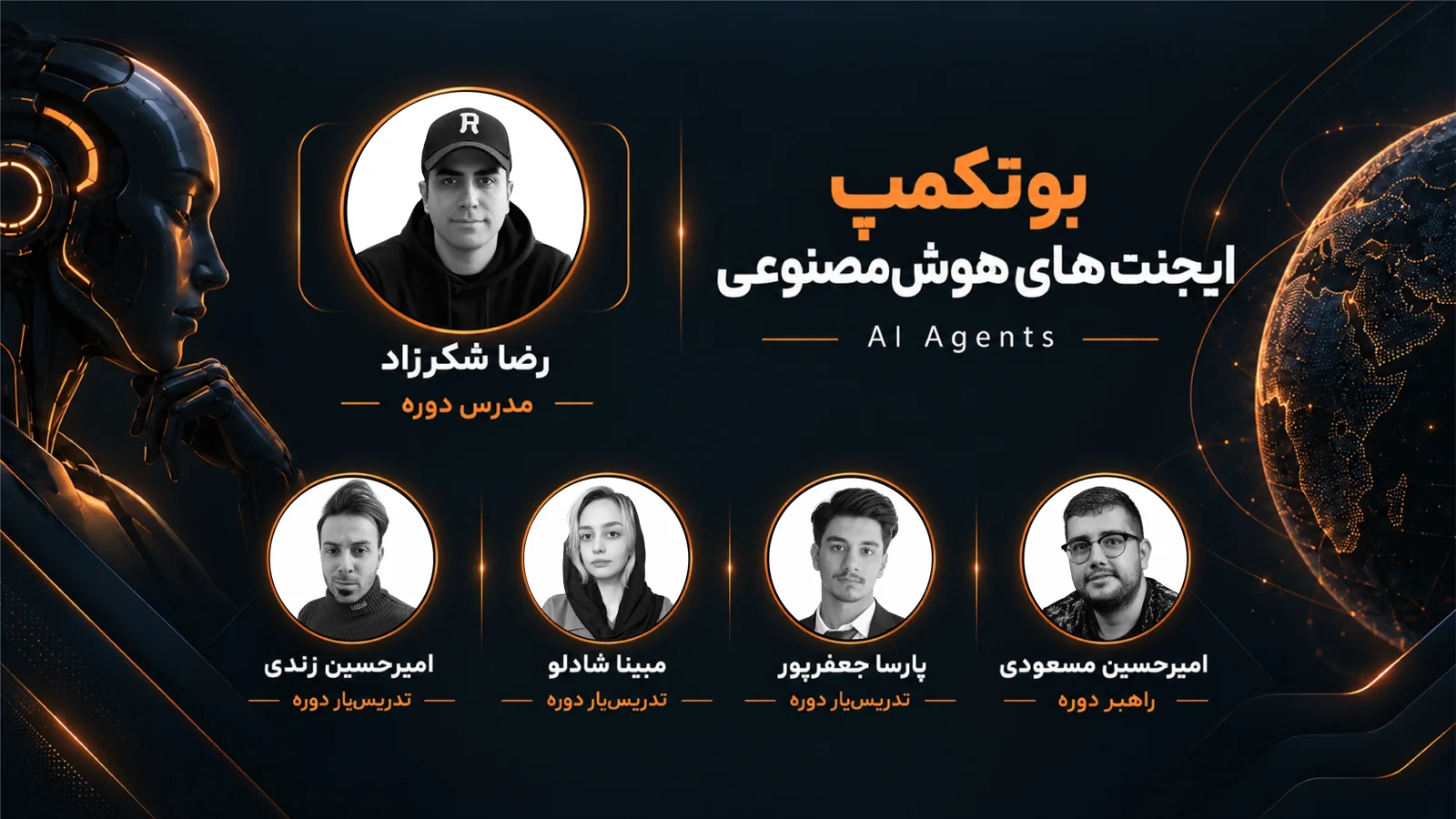
بوتکمپ ایجنتهای هوش مصنوعی
۴۲ ساعت در ۶ جلسه، کاملاً پروژهمحور؛ از طراحی تا ساخت ایجنتهای واقعی و ارائه در Demo Day برای شرکتها و سرمایهگذاران.
شروع: چهارشنبه ۱۵ مهر ۱۴۰۵
ctdrs.ir/cr18600←علم داده و هوش مصنوعی برای همه
۱۲۰ ساعت؛ مسیر کامل از پایههای داده و پایتون تا یادگیری ماشین و هوش مصنوعی.
ctdrs.ir/cr16814←اگر این جلسه برایتان مفید بود
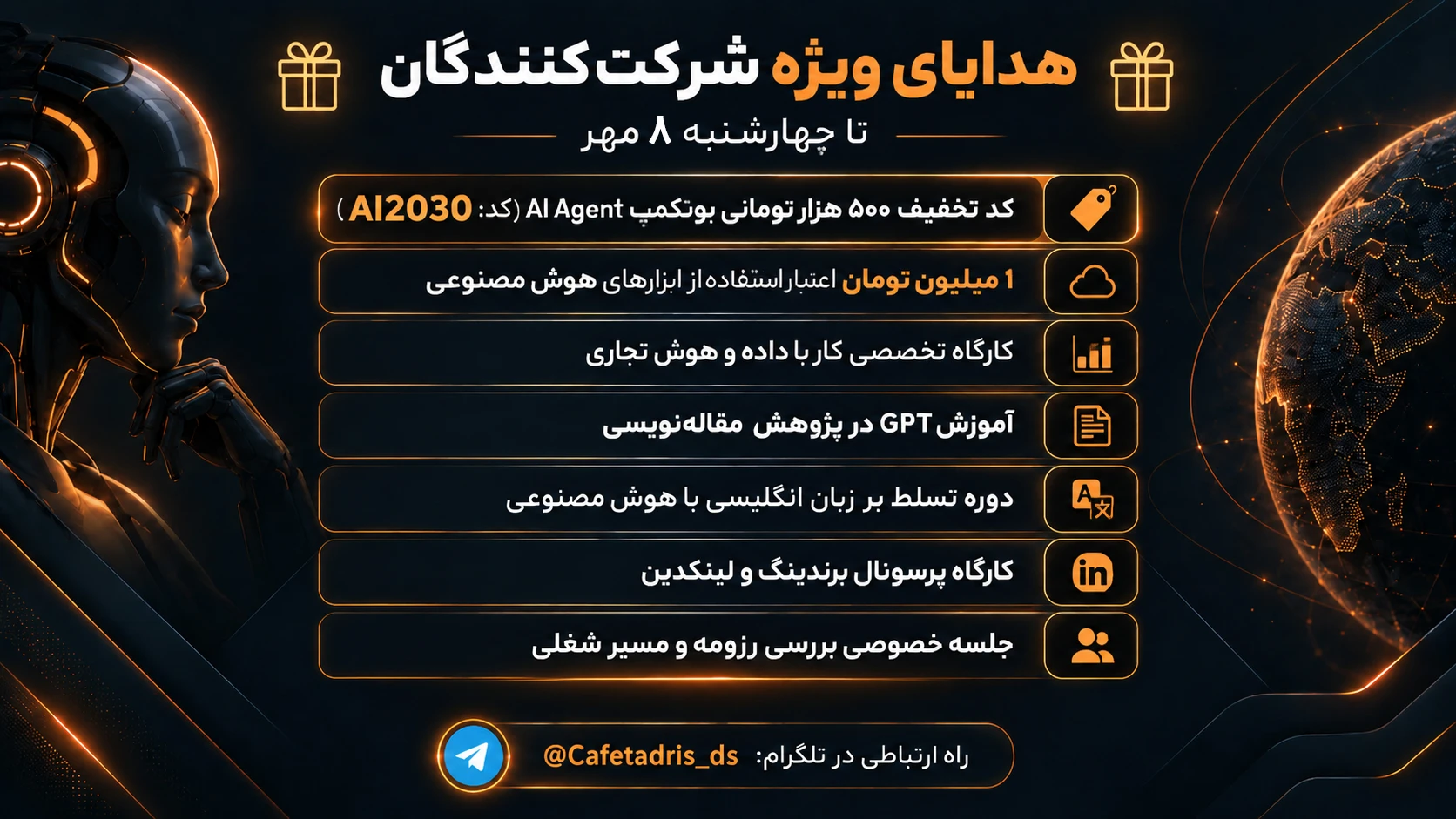
بوتکمپ «ایجنتهای هوش مصنوعی» همین مسیر را پروژهمحور و عمیقتر جلو میبرد؛ شروع از چهارشنبه ۱۵ مهر ۱۴۰۵. هدایای ویژه تا چهارشنبه ۸ مهر با کد تخفیف AI2030.